
BY: Keith S. Shikowitz, Editor in Chief/Investigative Reporter
In any major event in history, we always mention that there are unsung heroes. The problem is that we only mention that they exist as a group, we rarely recognize who they are individually. Women have been playing a very important part in the history of the American military going all the way back to the American Revolution where they had many different roles. These things are not taught in the regular course of American History Curricula in NYS. During Women’s History Month, they are cursorily spoken of but that is it.
Women played a crucial and multifaceted role in the American Revolution, contributing significantly to the war effort and challenging traditional gender roles.
Behind the scenes, they participated in many different political events such as boycotts of British good, organized events like the Edenton Tea Party demonstrating their commitment to the Patriot cause. Directly participated as camp followers providing essential services for the troops such as cooking, washing and nursing.
Some notable “unsung heroes” include Deborah Sampson who disguised herself as a man to enlist in the army, Molly Pitcher (Mary Ludwig Hays) who fought in the Battle of Monmouth after taking her husband’s place at an artillery piece
They were also writers and while their men were out fighting the wat, they managed the family farms and businesses. They also did fundraising to support the war.
As a result of this participation, gender roles were affected. Their contributions laid the groundwork for women in the 19th century to fight for Women’s rights. It was proven in the revolution that women could be po9litically and militarily active.
This political and military activism continued throughout American history in the Civil War, Spanish American War, World War 1 and in World War 2 they were made a part of the American Military with organizations like the WAVES, WACS and WASPS. They served as nurses in Korea and Vietnam and in the Gulf Wars and current conflicts they have battlefield and combat roles.
A number of women were honored at an Honoring Women Veterans event at the American Legon hall in Pomona on March 23, 2026, with Emily Klinkenborg being the recipient of the Freedom Award, whose mother is also a veteran. Edie Meeks, a Vietnam War nurse was honored by being asked to be the guest speaker for the event. There was a full house of people to honor them.
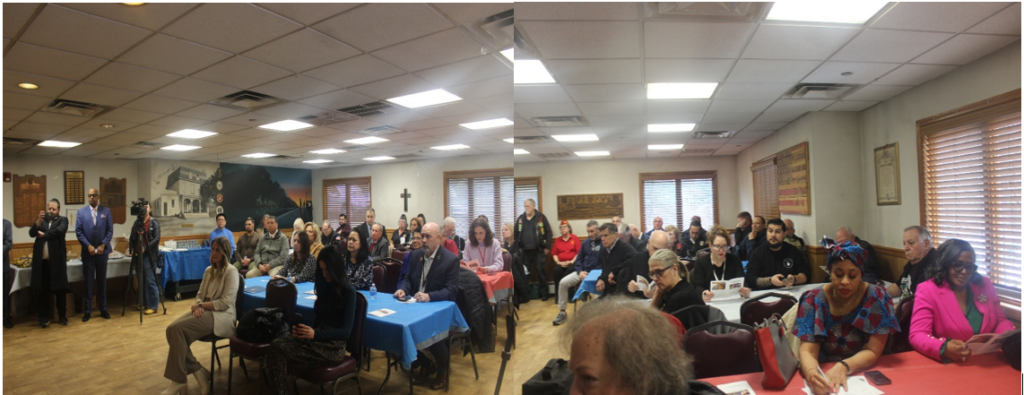
The ceremony began in the usual way any ceremony begins with the Pledge of Allegiance, the singing of the National Anthem and an invocation from a clergy person.
Susan Branam, Director of the Rockland County VSA emceed the event. She began by recognizing the elected officials who were present at the event. She then shared a brief history of women in military service.
“We have served since the beginning of our country. We were there in the Civil War, in the Revolutionary War, and we know that women served a vital part of our military efforts. Often times women were behind the scenes, doing seamstress work, nursing work, caring for the wounded, but they were still a vital part of the war effort.
We also know that certain women that were not allowed to serve in combat but yet still did. We had examples like Deborah Sanson and Harriet Tubman that actually disguised themselves as men and served in combat.
Often times we found out after the fact that they had served when we found them dead on the battlefields.
When we fast forward to World War 1, the military knew that they needed additional help, and so they started enlisting women into the Navy during World War 1. World War 2, we had such a greater need that they created specific programs for women to serve. There were WAVES in the Navy, there were WASPs in the Army Air Corps, and there were WACs in the Army.” Branam stated.
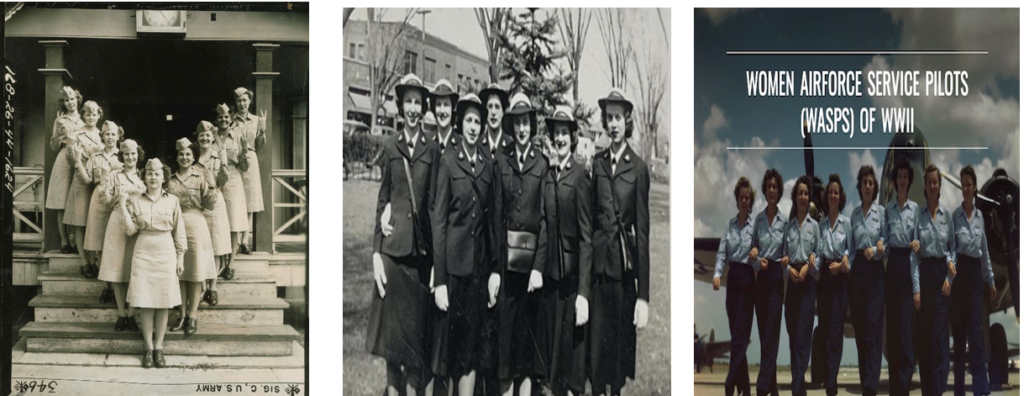
Next she wanted to bring the attention of the audience one such example in the county that the she was dealing with now. She pointed to her right drawing attention to two pictures on the back of the table which contained a number of pictures. The one she was referring to was that of Loretta Darcy. She went on to explain that Darcy was born in 1908 in Massachusetts, but she grew up in Clarkstown with her six siblings for the rest of her life and she got her private pilot’s license in 1939 and went into the WASPs by 1941. She ferried aircraft and she ultimately became a flight instructor. She was with the WASP until they were dissolved in December of 1944.
“We don’t know much else about her life after that point other than she died in 1976 and she is in an unmarked grave in Nyack right now. Unmarked because the government did not recognize her service. When this was brought to my attention several months ago, we started trying to correct that. I applied to the VA to try to get her a headstone, and I was told she didn’t have any service. We provided her orders and pictures that proved that she did serve, and I was denied again. Last month, I went to the coordinating council, which is the veteran leadership in the county, and asked them if they would purchase a headstone for her, and we’re in the process of doing that right now. The reason why she was not given a headstone is because she died in 1976. WASPs were not recognized for the service until 1977. This is another example of why it’s so important for us to recognize women and to remember our history.”
“Today we have two incredible women. They’re going to talk about their stories. They endured. They did well, they continue to serve. Even today we have women veterans that have a higher rate of suicide, unemployment, and homelessness, even more so than our male veteran counterparts. We still need to fight to get these women connected with services.”
She asked that if there were any women veterans in the audience, to please stand so they can be recognized for their service. “Thank you, ladies for your service and thank you for being here.”
She asked County Executive Ed Day to come and present the Freedom Award.
“Good morning, everyone. Is it still in the morning? Good morning yes.” Two people told him he still had 18 minutes left of morning. “All I can say is this, I’m really very privileged, proud and honored to be able to speak in front of all of you and to recognize a very part of our history, our military history. I want to thank you for joining with me today, to get the Freedom Award presentation. It’s an opportunity to get as an honor the remarkable service and sacrifice of our local military heroes. Today we have a distinct privilege recognizing an extraordinary veteran, Emily Klinkenborg. She served, 7 years in service in the United States Army. Emily Klinkenborg served with distinction, dedication, professionalism as a Captain.”
He said she did achieve a great, a great honor on her own, of her own rights. “As a Signal Corps officer, she demonstrated strong leadership in numerous roles and multiple deployments all around the world. Some of the locations that she had experiences when, with, including South Korea, Kuwait, and Hawaii. Her service earned her an impressive list of awards and commendations reflecting on both her excellence and unwavering commitment that she had on the service and on our country. What is equally inspiring is that Emily’s dedication to serve others did not end with her active duty.
“When she’s here at home, she continues to give back, through the work as a county employee. I know her that way. And she is on the Rockland Homes for Heroes board. Her contributions directly support initiatives that provide critical assistance to our veterans, and she has consistently stepped forward to make a meaningful difference in their lives. That’s truly hard work. There’s no other way to putting that. I want to thank you for that.”
“Emily is the epitome of the kind of leader who leads by example. We’ve seen that in her all this time. Her service to this nation, to this county and the service to the veterans and this country make her profoundly deserving of this recognition. With that Emily, on behalf of the community, the county and our country, I would like to thank you for your extraordinary service and with your continued service to our community. With that it is my honor to present to you the 2026 Freedom Award.”
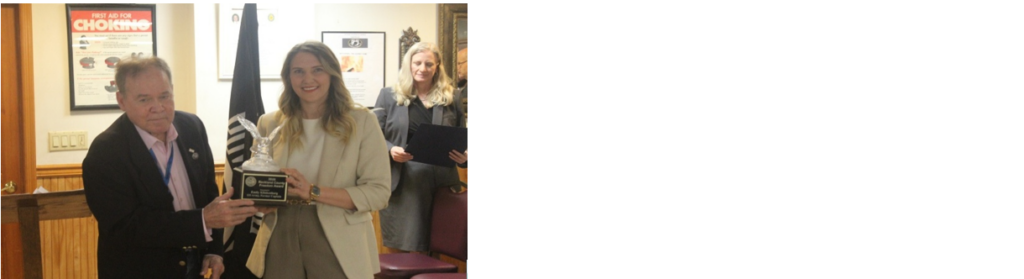
Freedom Award to Emily Klinkenborg
After Day made the presentation, representatives from Congressman Lawler’s, and State Senator Bill Weber’s offices and County Legislator Aney Paul presented Klinkenborg with certificates. After which she took to the podium.
Branam came back up to summarize Klinkenborg’s receipt of her awards and introduce the guest speaker Edie Meeks. “Thank you not only for your service, but also for your inspiring words. When we talked about her receiving this award we had a discussion.” Looking over at Emily, “I wouldn’t say that I twisted your arm. It got close, because she’s also humble, and so I really appreciate that.”
A lot of Mrs. Meeks’ speech is going to be video. Her accounting of her Vietnam experience is so moving that it needs to be heard, not just read about. I can write her words but sometimes hearing it from the source is the best.
“At this time, I’d like to introduce our guest speaker. Edie Meeks became a nurse before Vietnam, and when her brother was drafted, she decided to join the Women’s Army Nurse Corps, and she went to Vietnam. She has an incredible story of the things that she witnessed and continues to be a nurse to this day. Please help me welcome Edie Meeks.”
Meeks is a spunky, short grey-haired lady who grew up in Minnesota and went to nursing school in Minnesota in Rochester, Minnesota. “Usually, the podiums are a little higher and then I have to say can you see me? I was taller than this when I went into the Army Nurse Corps. You had to be 5’1” in order to be allowed in and so I was 5’1”, but I lied on my, I said I was 5’1.5” just so they would take me.”

After nursing school, she went up to North Central British Columbia and worked for a year in a 46 bed hospital and in 1967, she went down to Hollywood, California to visit her brother and that was the year of the big change for everybody where lots of ideas came up.
“I was with my brother who was selling encyclopedias door to door, and he wasn’t making too much money. I decided, well, I’ll just get a job, and at that time you could just walk into a hospital and say and they’d say, where did you graduate from? I’d tell them and they’d say, can you start today? It was wonderful. I stayed with him until he was drafted. When he was drafted, he decided he wanted to go into the Marine Corps instead of the Army. He joined and I stayed there in Hollywood. The whole time he was at Camp Pendleton. I was able to go to his graduation from boot camp. That was quite a graduation.”
Meeks explained that at that time, and it’s kind of hard to picture nowadays, but they would take anyone if they had two legs. “You were welcomed into any of the Corps, practically. There was this one great big guy, and he was wearing a special band on his arm. I said to Tom, ‘Well, what was that for?’ He said, well, he came in here, he was like 380. So, they have him dig a ditch and then fill it in and then dig another ditch and fill it in and so far he’s lost 100 pounds, and I thought, wow, he really must want this guy. After he joined the Marine Corps, I thought I do know that not all nurses are equal. If a nurse is someplace where she doesn’t want to be, she doesn’t necessarily do the best job. I wanted somebody over there that would take care of my brother if something happened somebody who wanted to be there. So, I thought, well, I better put up. I joined the Army Nurse Corps, and my brother, I called him and I said, I joined the Army Nurse Corps. Isn’t this wonderful? He said, oh, thank God the Navy takes care of the Marines. So at least you wouldn’t have this.
“At that time, I have to say nurses were not soldiers. We were not allowed to carry a weapon. We could qualify on the M16 if we wanted to which I did. Coming from Minnesota, everybody had a gun because they all hunted.
I figured if somebody comes through the door, at least I’ll know what to do, nobody else is standing on two feet. I called my brother again and I said, “I don’t know what you were complaining about with the basic training.
The maid comes in every day and… He just about went wild. He couldn’t believe it. But when we were there in basic training, what they taught us was how to do things that we wouldn’t necessarily do because if things got so bad over there. That you just are up one level, so.
She said that was so hard for her for a lot of them, because they couldn’t tell the parents what wonderful kids they had. You’re not supposed to get in touch with them at all. Which makes sense because if they wrote them a letter, they might get it before the army let them know what was going on.
“One of the things that we had to do in Saigon was stabilize them in the intensive care unit so that they could go on to Japan to have the big surgery that they needed. We didn’t know what happened to a lot of our patients. There was only one patient that we found out what happened to because he wrote us a letter. He had had, shrapnel hit part of his heart, and they opened him up right outside in the triage area and he lived. He wrote us from Walter Reed, and he said, “I’m doing fine and it was such a wonderful thing. He stayed with us for a fair amount of time. Usually, the guys wouldn’t stay with us that long. We work 12 hours a day, 6 days a week and the gal that I was a roommate with also worked in the intensive care unit.”
Meeks went on to explain how it was in the hospitals in Vietnam. They never discussed the patients. They had to keep a professionalism and were not able to mourn the ones that died. There was no time to because there was always the next big thing that kept them going.
After her service, she came home and got married. Had two children and lived in Garrison for 30 years. Through the perseverance of a good friend Diane Carlson Evans, she got involved in the Vietnam Women’s Memorial that is next to the Vietnam War Memorial in Washington D.C. Evans was trying to get Meeks to speak at the dedication of he memorial. She really didn’t want to but she said she would do it under one condition that she gets to stop whenever she wants to and leave. He got her way.
She got the chance to speak to a class of 75 women at Mount Holyoke College, an all-women’s college, where her daughter was going to school about her Vietnam experiences. Her daughter told her about a professor in a class about Vietnam who said that “You women will never know what it’s like to be in a war.”
After World War 2, the Soldiers, Sailors, Marines and Army Air Corps who fought in the war were welcomed home as heroes. Parades, medals, keys to their home cities and towns, real celebrations. The Vietnam War was not a popular war. Many people, young and old felt we had no reason to be there fighting in their civil war. This was the first reel war. Meaning that we saw it on the nightly news every day. Enemy propaganda was spread fast and furious to the world and it was not complimentary. Unfortunately, the veterans that came home from Vietnam, were barely acknowledged. When they were, they were called baby killers and other things.
“She said, mom, I’m taking a course on the 60s. I said, is that history already? She said it was a dynamic decade.
Meeks replied to her daughter’s request by stating, “If your professor says, okay I will.”
“I started by saying, I don’t know about the politics, but I’ll tell you what it felt like to be a woman in this situation. At the very end, one of the little gals came up to me and she said, oh, Mrs. Meeks, I would have welcomed you home. It was the first time I really felt welcomed.”
After the ceremony and speeches were over I had the honor of having a conversation with Mrs. Meeks about her experiences and got some clarification of certain things she said. She is a formidable woman who stands for what she believes in and will not let anyone disparage her or any other Vietnam Vet. As a former history teacher who taught about the Vietnam War, using stories from people I knew from my childhood who fought there, I was enthralled to hear her stories and wished I knew her then because she would have been a great guest speaker. You can watch the conversation.
I was also able to speak with Emily Klinkenborg getting further information about her service and life after she left the service. She did not retire as was earlier stated. She decided not to renew her service. Here’s the rest of her story.
As stated earlier, women have been working with and enlisting in the military of the United States since the American Revolution through today. They have served with distinction and were not treated equally to men in pay or status until recently. In this month of recognizing the contributions of women to American history, we need to really thank those women who risked their lives and the many who have died to preserve the country our founding fathers set up, not for themselves, but with the future generations in mind.