
The Consumer Price Index could be significantly overstating price reductions associated with the new Medicare drug negotiation program.
he Consumer Price Index for Prescription Drugs (CPI-Rx)—a key measure of aggregate prescription drug price levels—had a historically large decline in the first nine months of 2026. Amid a flurry of policy changes and rapidly evolving drug markets, it is unclear what is driving this decline. In this article, we argue it may largely reflect a measurement issue: The CPI could be significantly overstating price reductions associated with the new Medicare drug negotiation program. Although the CPI methodology itself has not changed, the new program has altered where discounts are applied for some drugs and, in turn, measured price levels.
Recent Declines In The CPI-Rx
The CPI is a measure of the average change over time in the prices of items such as food, clothing, shelter, along with prescription drugs. The prescription drug component of the CPI reflects transaction prices of prescription drugs purchased at retail pharmacies, where the price includes the full reimbursement, including the patient payment and payer reimbursement. Importantly, rebates that are paid by drug makers to insurers are not reflected in these retail pharmacy prices. This is consequential because rebates can be very large, often around 50 percent of the gross drug price.
In general, changes in the CPI-Rx can reflect increases or decreases in (pre-rebate) prices of existing products or a shifting composition of drugs purchased. Perhaps most notably, this series can decline if the entry of a low-cost generic drug causes consumers to substitute away from a more expensive brand drug.
In contrast to steady increases in recent years, the CPI-Rx declined significantly in 2026. Through September 2026, the CPI-Rx has fallen by 4.6 percent from its value in December 2025 (exhibit 1). This roughly coincides with several policy changes, including the introduction of Medicare-negotiated prices for select drugs in January 2026, the launch of TrumpRx in February 2026, a growing direct-to-consumer market for certain drugs, and the announcement of pricing agreements between the current administration and several drug manufacturers beginning in September 2025. The decline since December 2025 is larger than any previous year-over-year decline in the CPI-Rx since the index began in 1969, with the largest year-over-year decrease occurring in September 2026. These developments have implications beyond the health sector because the CPI-Rx feeds into broader measures of consumer inflation and, in turn, price indexes used in the national accounts and gross domestic product estimates.
Exhibit 1: Consumer Price Index for prescription drugs, changes, December to September, 1969–2026
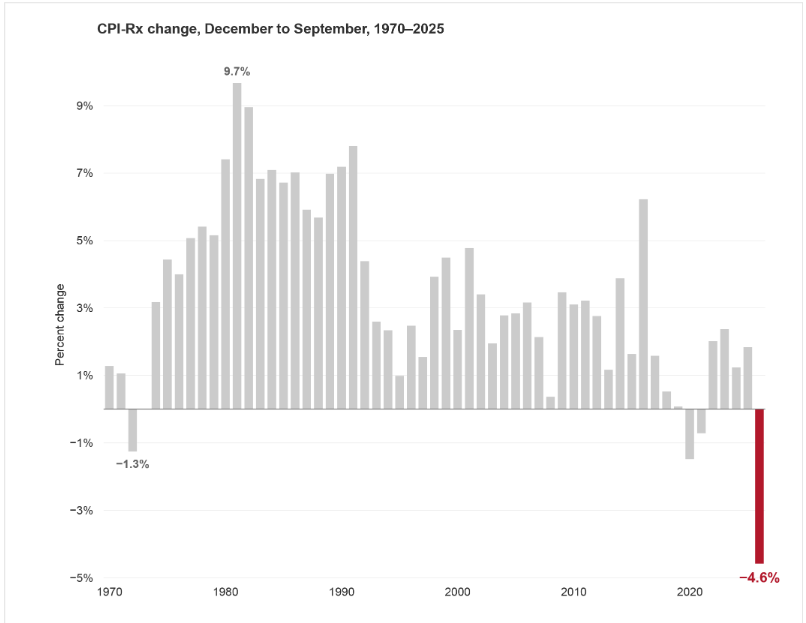
Source: Authors’ analysis of Bureau of Labor Statistics, Consumer Price Index for all urban consumers, prescription drugs (series CUSR0000SEMF01). Notes: The exhibit shows price changes from December of the prior year to September of the current year going back to when the data were first available. The most recent time period shown in the exhibit is December 2025 to September 2026.
How Medicare Drug Price Negotiation May Affect Measured Price Levels
While several factors may help explain recent declines in measured prices, a substantial portion may reflect the CPI-Rx overstating price reductions due to the new Medicare drug price negotiation program. The Inflation Reduction Act of 2022 included a provision that allowed Medicare to negotiate the prices of brand drugs that have high sales, no generic competitors, and have been on the market for enough years. The first cohort of 10 drugs were selected in 2023 with negotiated prices taking effect January 1, 2026.
When announced, the negotiated prices for the first round of drugs were about 63 percent lower than full list prices (weighting equally across products) but only 22 percent lower than existing post-rebate transaction prices. Critically, the new negotiated discounts were required to be offered at the point of sale.
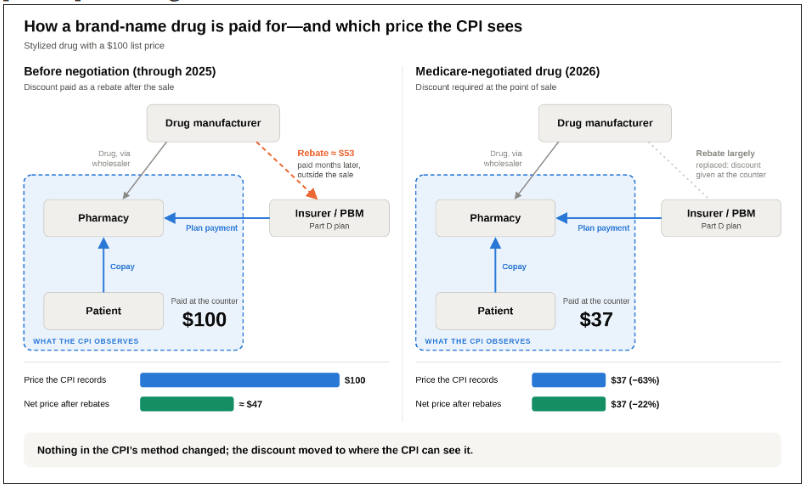
To illustrate how this affects measured price levels, exhibit 2 follows a hypothetical drug with a $100 list price that was selected for the first round of Medicare price negotiation. Prior to 2026, the pharmacy was paid $100 at the counter, split between the patient’s copayment and the insurer’s payment. This $100 is the transaction that the CPI records. Months later, the manufacturer pays a confidential rebate, here $53, to the insurer or its pharmacy benefit manager (PBM). After the $53 rebate, the drug’s net price is $47. Because the rebate is paid after the sale and outside it, it never shows up in the CPI.
Exhibit 2: Industry payment structure and Consumer Price Index for prescription drugs measurement
Source: Authors’ analysis.
Beginning in 2026, Medicare negotiation lowers the net price from $47 to $37 and changes where the discount is applied (these numbers are based on the 22 percent average price reduction from the first round of negotiation). The new lower negotiated price of $37 must be applied at the point of sale, so the CPI-Rx now sees it. Measured at the counter, the price falls from $100 to $37, or 63 percent, the same gap between negotiated and list prices that the Centers for Medicare and Medicaid Services reported. Measured net of rebates, it falls from $47 to $37, or 22 percent. The CPI’s methods did not change; the discount moved to where the CPI-Rx can see it.
These drugs have sufficiently high sales that this distinction is important. The first 10 products subject to negotiation accounted for about 20.0 percent of total Part D gross covered prescription drug costs in 2023, and Medicare financed 41.8 percent of net retail drug spending. Assuming this ratio is similar for gross spending, negotiated drugs accounted for around 8.4 percent of total retail spending. That means a 63.0 percent price reduction for these drugs would lower the CPI-Rx by 5.3 percent. In contrast, the true reduction in post-rebate prices would only have reduced prices by around 1.8 percent. Therefore, the prices observed by the CPI would imply an effect of Medicare negotiation on the overall prescription drug price level that is nearly three times as large as the true effect.
If prices for the remaining 91.7 percent of prescription drug spending unaffected by Medicare negotiation increased by 1.6 percent, the average rate of increase over the previous five years, the net change in the CPI-Rx would be a decline of about 3.8 percent, within a percentage point of the decline actually observed. This exercise is intended to illustrate the potential magnitude of the measurement effect rather than provide a precise decomposition of the 2026 decline. The actual effect could be larger or smaller depending on the drugs and transactions represented in the CPI sample and other details of the index methodology. Other developments, including generic entry for high-volume drugs and additional policy or market changes, may also have contributed to the decline in the CPI-Rx.
Looking Ahead
Each year, a new cohort of drugs will be subject to lower negotiated Medicare prices, offering an opportunity to test this theory in upcoming years. The 2027 cohort represents a similar 15 percent of total gross Part D spending, and new negotiated prices will average a nearly identical 62 percent reduction from list price, suggesting a broadly similar effect next year.
More broadly, this episode highlights just how difficult it is to measure prescription drug prices in a market where the amount paid depends on a complex and changing set of list prices, rebates, negotiated discounts, insurers, PBMs, and government programs. A price index can only measure the transactions it is designed to observe. When the way discounts are delivered changes, as it now appears to be happening with Medicare negotiation, even an unchanged statistical methodology can begin to measure something different from what it captured in the past. There also remains an important question about how Medicare-negotiated prices will ultimately affect insurance design, premiums, and consumers’ out-of-pocket costs.
Nevertheless, the patterns documented here suggest that recent changes in measured price levels should be interpreted with some caution in the near term. More broadly, the challenges in measuring a sector with complex pricing and changing payment policies highlight the importance of investments to refine and update economic measurement. Getting these measurements right matters for evaluating drug-pricing policy, understanding health care spending, and accurately measuring inflation and economic growth.
Authors’ Note
The views expressed in this article are those of the authors and do not necessarily represent the Bureau of Economic Analysis, the Department of Commerce, or the Medicare Payment Advisory Commission.