
Rockland Post Desk
Long before the roar of the Hudson River ferries and the bustle of Nyack’s streets, Rockland County was a quiet but vital corridor on the path to freedom. During the era of slavery in the United States, escaping slaves fled south-to-north, seeking refuge in the North or eventually Canada. Many of them passed through Rockland County, New York, aided by brave residents who risked fines, imprisonment, or worse to help strangers find liberty.
A County That Helped Hide Freedom
Rockland’s location made it a natural route. Its towns—Nyack, Piermont, Haverstraw, and Orangetown—lined the western banks of the Hudson River. From nearby New Jersey, fugitives often crossed the river by small boats under the cover of night. Once on the Rockland side, they followed hidden paths through dense woods, winding roads, and riverside trails toward safe houses scattered across the county.
Quaker families and other abolitionists played a pivotal role. Churches, too, offered protection, acting as quiet beacons of hope. Inside ordinary-looking homes, escaping slaves were hidden in attics, cellars, or secret rooms, their presence known only to a trusted few. Some residents of Rockland coordinated with contacts in neighboring counties, creating a chain of safe havens stretching toward Canada.
Harriet Tubman’s Influence
Though Harriet Tubman (c. 1822–1913) never personally traveled through Rockland County, her daring escapes and leadership on the Underground Railroad inspired local residents. Families and church members in Rockland adopted similar methods: secret routes, coded signals, and coordinated networks of safe houses. Tubman’s legend served as a beacon of courage, showing what was possible even in the face of severe risk.
Key Figures in Rockland County
Some families and individuals were particularly known for their role in helping fugitives:
Hasbrouck family – Huguenot-descended family in New City and Haverstraw, providing shelter and aid.
DeBaun family – Assisted in safe house operations and coordinated with neighboring communities.
Dey family – Supported anti-slavery efforts in Orangetown.
LeFevre family – Offered hidden rooms and barns to protect escapees.
Quaker pastors and church members – Provided community support and coordinated safe passages.
Free African American guides – Played essential roles in navigating safe routes and delivering fugitives to the next station.
Courage in Secrecy
The Fugitive Slave Act of 1850 made helping runaways a federal crime, yet the network endured. Families coded signals into everyday objects: a lantern in a window might mean ‘come here,’ while certain knocks on doors indicated safe passage. Every step northward was fraught with danger, yet the people of Rockland County kept the path alive.
African American residents were also crucial guides, blending local knowledge with daring courage. Together, they helped countless men, women, and children reach freedom.
Commemorating Rockland’s History
Today, Rockland County remembers its role in the Underground Railroad through historical markers, plaques, and statues:
Nyack Historical Markers commemorate local participation, including sites associated with Edward and Cynthia Hesdra, Black residents believed to have helped escaping slaves. One marker is located at the corner of Main Street and Route 9W, and another marks a nearby brook that served as a landmark for fugitives.
African American Historical Society of Rockland County maintains records of these sites and advocates for their preservation.
A statue of Harriet Tubman, titled ‘Journey to Freedom,’ was displayed at the Haverstraw African American Park, honoring her legacy and symbolically recognizing Rockland’s contributions to the Underground Railroad.
Local communities continue to add plaques, benches, and interpretive panels to ensure that the stories of courageous individuals, including the Hesdra family and other guides, are not forgotten.
A Lasting Legacy
While many of the actual safe houses are now private homes, the stories persist—a reminder that ordinary communities can accomplish extraordinary acts of humanity. The courage of those who risked everything, both the fugitives and their allies, is a testament to the enduring fight for freedom.
On the Map
The accompanying map highlights:
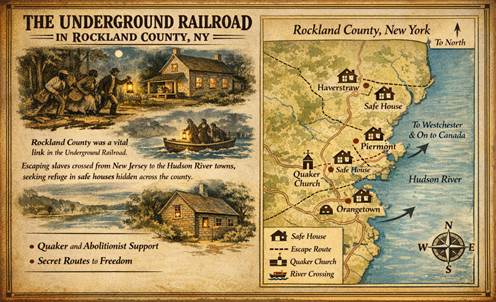
Escape routes from New Jersey into Rockland County
Safe houses in Piermont, Orangetown, and Haverstraw
Quaker churches that offered shelter
River crossings along the Hudson leading north toward Canada
The inspiration of Harriet Tubman, symbolizing courage and leadership for all who helped fugitives in the area
Families and individuals who played key roles, including Hasbrouck, DeBaun, Dey, LeFevre, and local African American guides
Historical markers and commemorative plaques in Nyack and Haverstraw, and the Tubman statue at Haverstraw African American Park