
BY: Robert Jowaiszas, Community Editor/Reporter
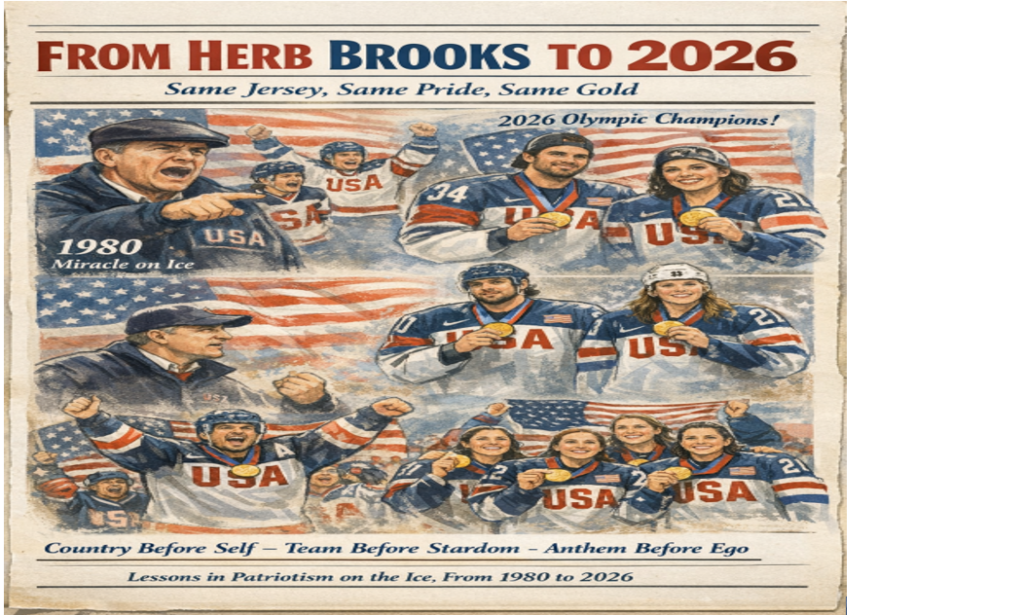
In 1980, a group of American kids walked into Lake Placid and faced what many still call the greatest hockey team ever assembled — the Soviet Union. They weren’t supposed to win. They weren’t even supposed to be close. But Herb Brooks understood something that went far beyond systems and conditioning. He kept his players away from the media, pushed them to the limit in practice, and repeated a message that became the soul of that team: you are not here for yourselves — you are here for the United States of America. What followed in the Miracle on Ice was more than a victory. It was a defining moment of pride, discipline, and belief that reshaped hockey in this country and inspired generations of players who filled rinks from Minnesota to the Hudson Valley.
The gold-medal runs at the 2026 Winter Olympics came in a completely different era. These were not unknown college players. They were NHL stars, professionals with global recognition, major contracts, and year-round media attention. Yet when the pressure reached its highest point, the image looked strikingly familiar. Players stood shoulder to shoulder, arms linked, singing the national anthem with the same intensity seen in Lake Placid. The system came first, the backcheck came first, the blocked shots came first. It was not an All-Star collection of individuals. It was a team.
For the Team USA men’s ice hockey, leadership started with captain Auston Matthews, whose presence set the tone shift after shift. Behind him, Connor Hellebuyck delivered the kind of goaltending that wins championships, Jacob Slavin and Charlie McAvoy controlled the game with composure on the blue line, Jack Eichel dominated in all three zones, and Matthew Tkachuk brought the emotion and physical edge that every gold-medal team needs. No one chased personal numbers. Every player accepted a role.
The same identity defined the Team USA women’s ice hockey, where captain Hilary Knight once again became the heartbeat of the program and the standard for American hockey. Kendall Coyne Schofield’s speed changed games, Brianna Decker’s vision controlled possession, Caroline Harvey showed the rise of the next generation on defense, and Aerin Frankel delivered under the most intense moments in net. Their performance was not a side story to the men’s tournament. It was an equal chapter in the same tradition, and women’s hockey deserves to be recognized in the same breath whenever the story of American gold is told.
From the youth level to the National Hockey League, hockey has held onto something that feels increasingly rare in modern sports. The handshake line still matters. The locker room still matters. The structure of the team still matters more than the spotlight. Players are taught from the beginning that the name on the front of the jersey carries more weight than the one on the back, and even at the highest professional level the culture has largely stayed rooted in that belief.
And that brings the story full circle.
In 1980, Herb Brooks built a team that learned to put country before self. In 2026, a group of professionals who live in the brightest spotlight in sports showed that the same standard still exists. They bonded. They sacrificed. They stood together for the anthem not because it was a requirement, but because it meant something.
At a time when so much of the national conversation is built on division, hockey continues to offer a different picture of what patriotism looks like. It isn’t loud. It isn’t performative. It doesn’t depend on who is in office or what the political climate happens to be. It is the quiet understanding that when you pull on that jersey, you represent something bigger than yourself.
The lesson from Lake Placid to 2026 is not just about gold medals.
It is that love of country, commitment to team, and respect for one another are not outdated ideas. They are still being lived — shift by shift, line by line — on the ice.
And in a time when those values are often debated, American hockey is still showing h