
Rockland Post Desk
Senator Bill Weber sponsored a blood drive at the Haverstraw King’s Daughters’ Library on December 29, 2025. When asked why he got involved in this venture a few years ago, he stated, “Blood donations save lives; there’s no question about it. I was proud to partner with the New York Blood Center on this lifesaving initiative, and I’m deeply grateful to all who gave so selflessly today.”
John Mulgrew, Weber’s Chief of Staff said, “We do them regularly, since his time in office we’ve done dozens of blood drives.”
Many people have a major dislike of needles. This keeps people from doing things like donating blood. Keith Shikowitz was in this category, but he also had another reason for not donating. He is a type 2 diabetic, and he had been told he couldn’t donate because of that. That information changed earlier this month.
“We found out earlier this month that as a diabetic, I can as long as my sugars are under control. Mine are. I have the Omnipod 5 which gives me insulin at a preset rate and the Dexcom G7 which monitors my glucose levels. Each of these work 24/7. At my last blood work up on December 19, my A1C (sugar level) was at 6.6 which is good. So, I decided that I would donate.” Shikowitz said.
He added, “One main reason I decided to donate, in spite of my total dislike of needles, was that on November 11, 2023, I had a heart attack because I had two clogged arteries. One was 80% clogged and the other was 90%. Well, when I do something I go all the way or I don’t do it. I had a double bypass three days later and I am sure that the blood they had to give me was donated by someone I didn’t know. It saved my life. Now I can return that favor to someone who might need it to save their life.”
You don’t just walk into a blood donation event, sit down and donate. There is a whole procedure here before that happens. “I had to go check in and then fill out a questionnaire on the computer and go get checked out medically. They check your blood iron, If it’s low you can’t donate. They check your blood pressure and temperature. If all of these things are okay, you go and wait until one of the people (I call them vampires) who are taking the blood calls you to the chair. Mine were okay.”
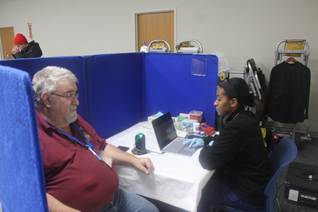
He then explained the remainder of the procedure, “Before I sat down in the chair and asked the man to take from my right arm. Being left-handed, I try to avoid things like that in my left arm in case of a problem. Continuing the procedure, he checked my arm to make sure my veins were easily accessible.”
Shakespeare said, “What’s in a name.” Well, a name can get you confused with someone with the same name.
One of the people donating was named Theresa Kenny, no relation to the Orangetown Supervisor.
How long has she been donating blood?
“Probably a little over 20 years, usually every twice a year or so.” This is about at least 40 times she has donated.
“This is actually the only time this year things have gone, but usually twice a year they have blood drives here at the library, sometimes at the church, the clubs, things like that, and I just, take advantage of them when they come up.”
One thing about Bill Weber and the people who work for him is that they don’t just ask others to do things. They get out and do it themselves as well. This time, Mulgrew was there donating blood. He was doing a double red cell, donation which is a 45-minute procedure as opposed to the seven-minute procedure Shikowitz and others dealt with.

“Like I said, I’ve never done it before, but my understanding is they take the blood out of you and it goes through the machine, they put it back in and they just take out the platelets that they need. I don’t know, exactly what it is but I’ve been told they’re able to help more people with it as a result.”
Donating double red cells (also called Power Red or SuperRed) uses an automated apheresis machine to collect two units of oxygen-carrying red blood cells while returning your plasma and platelets, allowing you to donate more red cells than whole blood, typically every 112 days, and is crucial for patients with sickle cell anemia, trauma, or surgery. Donors must meet extra height and weight requirements, and the process is safe, taking slightly longer than a whole blood donation.
“I donate regularly, but this was the first time I was doing this. They always kind of try to upsell you on that. ‘Oh, if you have the time, why don’t you sit and, and give the, the extra donation. It’s the spirit of giving or the season of giving.
How long in advance do these events have to be planned?
“This one today, he arranged at the beginning of December we’ve had been talking with the New York Blood Center to try to find one that works. Typically, what will happen is they plan these a year in advance, the Senator being linked to them is relatively recent, but it’s just to help spread awareness. We have the ability to reach more people with between our newsletter and our, you know, media contacts such as yourself. By getting the Senator involved, more people know about it, and more people are able to show up.” He stated.
Normally they do this further in advance. Because of the holiday we were kind of rushing this one a little bit. We did get it out on our newsletter last week. Normally it would be at least 3 weeks in advance.
Senator Weber is constantly holding events and getting out into the communities in his district to see what the people need and what he can do to help them get it. What else does the Senator have going on over the next few weeks?
“Well, the session is going to start up in Albany on January 7th, so we’re excited, Do that once again. It’s always interesting. We always try to make a difference and try to pass important legislation.
A person behind me who had given some coats to people he knows who needed a winter coat from the coat drive asked what the final count was on the coats. The answer is 8,122 pounds.
The person added the people that we gave the coats to are very grateful. They told us to thank the Senator for doing that.
Events like this can’t run without people volunteering their time. One such person is Max Booker, a Sophomore at Albertus Magnus High School. His volunteering, as well as because of his community spirit, helps him get to the 20 hours of community service students need towards graduation.
What made you choose this as part of your community service?
“I come to this library quite often and that’s going to make me go it’s a place I’ve known. I’ve come to it since I was a small plus, an activity like this is a great place to be service at because it’s very productive and what we do the blood drives it’s a service to the community. The blood drive, I mean, it’s long. I can get a lot of hours, but besides that it’s great because this is, a program that’s very useful, obviously it does save lives.”
He was not donating. He said he might be too young to donate. “I don’t know exactly, but it’s good to help those who do.”
Paul Serra has been donating blood for about 10 years and ended up donating at this one after his wife called him to tell him about it. One problem he has about doing this is that he’s definitely afraid of blood. “I usually do it a few times a year, just I feel like it’s a good thing to do. I just do it like, you know, like I said, someone’s got to do it, right, so, so it’s my way to give.”

When asked how he felt about Senator Weber setting this up, he added, “I mean, without them, you know, what would people do, right? I just think everyone should donate if you’re capable of. It’s a way to give back to people. It might be you that needs it somewhere.”
Paul’s wife Sheri also had some things to say about the blood drive and giving blood. “I actually found out about this when I went to return a book and saw they were doing a blood drive and figured I would give it a try. I’ve donated in the past, but I usually, my blood iron is usually too low to donate, but not today. By donating, I feel like it’s me doing my part to help others. The community service type thing.
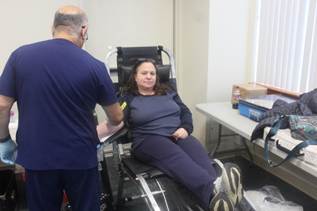
She started trying to donate blood about 10 to 15 years ago and figures she has donated between 20 and 30 pints over that time.
“I probably failed more times than I passed. I have a general problem with my blood iron. Even with that problem I keep trying to give blood. Sometimes I succeed and sometimes I don’t. But I always try and hope for the best. I want to say to the community that people should get out there and give and help your community. It’s a worthy cause.”